
Bollywood long hogged India’s cultural export story. Now a quieter revolution was underway, one drawn in pixels, not celluloid. PowerKids Entertainment, one of India’s most prolific children’s animation outfits, was betting that the country’s mythological treasures and literary borrowings could be spun into durable global franchises. Think less outsourced cartoon factory, more homegrown Disney-in-waiting.
PowerKids’ chief executive and managing director, Manoj Mishra, was a fixture at Annecy. For him, events like Annecy and its industry market, Mifa, were where strategy got tested against reality: broadcasters, distributors, licensing partners, and co-production financiers from dozens of countries, all under one roof. “These platforms are catalysts for collaboration, innovation, and long-term relationship building,” he said. Translation: deals got done there, and PowerKids intended to be at the table.
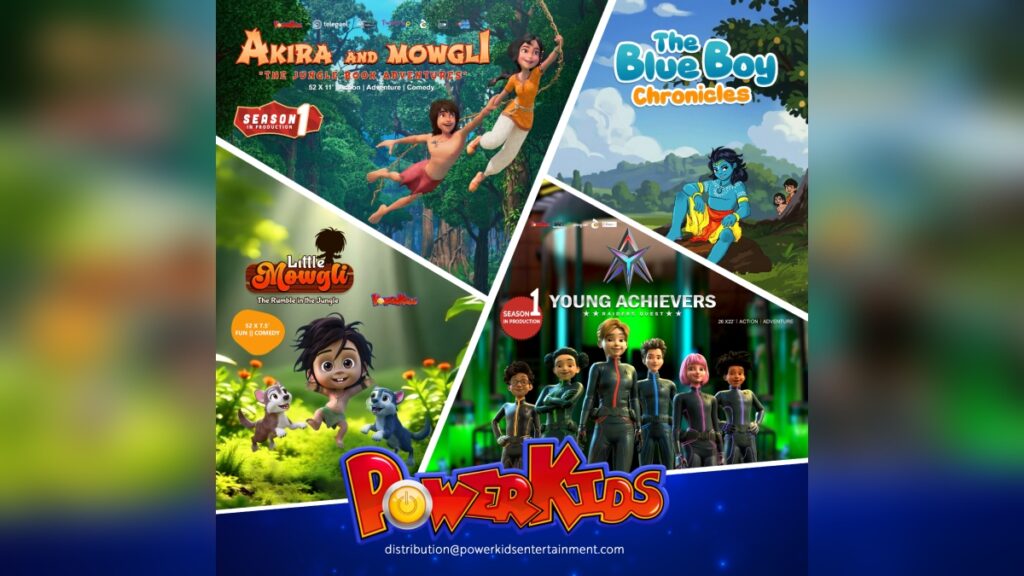
The studio’s most ambitious bet was Adventures of Akira and Mowgli, a reimagining of the Jungle Book universe that introduced Akira, a young heroine, alongside the iconic feral boy. The move was well-timed. Nostalgia for Kipling’s world ran deep across generations, while a contemporary female protagonist broadened the audience. A companion preschool series, Little Mowgli, extended the franchise to younger viewers, a deliberate strategy to engage audiences early and retain them longer.
Equally telling was Young Achievers Academy, a sci-fi action series in which young cadets battled rogue artificial intelligence. The premise was almost algorithmically calibrated for the anxious 2020s: teamwork, courage, innovation, and a villain ripped straight from today’s headlines.
Yet the project that best reflected PowerKids’ ambitions was The Blue Boy Chronicles, a co-production with Cayenne Pepper Productions that reimagined Krishna as a relatable young adventurer navigating friendship, identity, and leadership. Rather than exporting mythology as spectacle, the studio aimed to tell universally resonant stories. As Mishra put it, “We believe culture should serve as a bridge rather than a boundary.” The challenge lay in creating narratives strong enough to connect with audiences from Varanasi to Vancouver, and PowerKids was confident it could.
India’s animation industry, once valued primarily as a low-cost service hub for Western studios, now boasts original IP creators with genuine creative confidence, backed by world-class technical talent. What had lagged was the infrastructure for international expansion, co-production financing, global distribution, and licensing ecosystems. That was precisely what the Annecy circuit helped to supply.
PowerKids’ long-term vision extended well beyond television screens: publishing, consumer products, gaming, and digital experiences. The logic was familiar to anyone who had watched how Marvel or Pokémon built empires: the screen was only the beginning.
Mishra was clear-eyed about what the next generation of viewers demanded. “They don’t simply consume content,” he said. “They seek deeper connections with the worlds and characters they love.” In an era of infinite scroll and shrinking attention spans, building worlds that outlast a single series was not just good creative philosophy; it was the only viable business model. India, long a storyteller to the world, was now trying to own the stories it told. The credits, for once, would roll in its favour.
