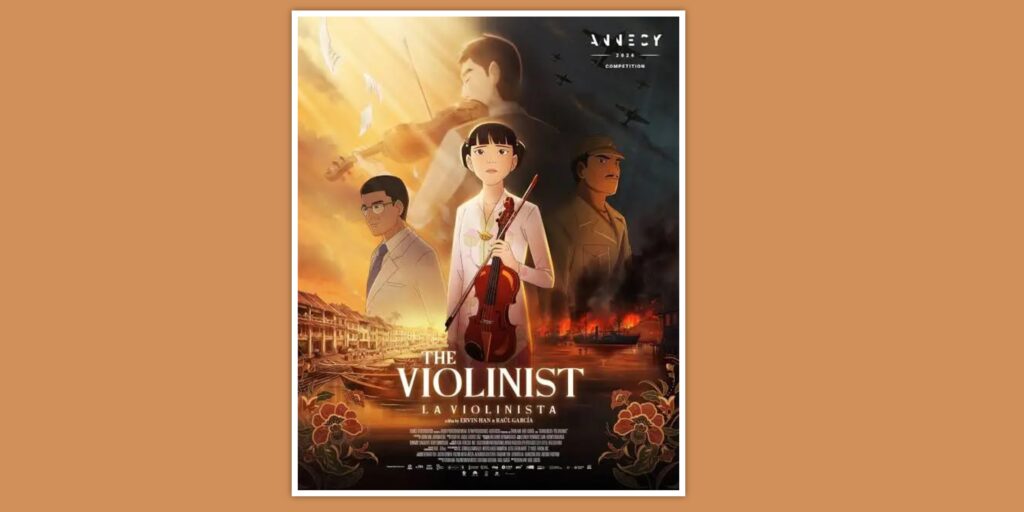
The Violinist is a profound cinematic symphony, where evocative animation and a soul-stirring score intertwine to leave audiences utterly spellbound.
For nearly a decade, The Violinist remained more than just a film for Ervin Han, it became a deeply personal journey. Han, the co-founder of Singapore-based Robot Playground Media had spent years nurturing the project from an award-winning short into an ambitious international animated feature, navigating the challenges of financing, creative development and global collaboration along the way. That journey culminated this year at the Annecy International Animation Film Festival, where The Violinist not only premiered in competition but also emerged as one of the festival’s biggest winners, taking home the Cristal for best feature and the SACEM Award for best original soundtrack.
Set against the backdrop of Southeast Asia during World War II, The Violinist follows the friendship of Fei and Kai, whose lives become intertwined through music amid the horrors of war. While deeply rooted in a specific chapter of regional history, the filmmakers believe the story ultimately transcends geography, exploring universal themes of humanity, memory, resilience and the healing power of art.
In an exclusive conversation with AnimationXpress at Annecy, film’s directors Ervin Han and Disney veteran Raúl García reflected on the film’s decade-long evolution along with International Emmy-nominated Japanese producer Takafumi Yuki. The trio spoke about the responsibility of portraying overlooked histories, developing a visual language that blends anime with European influences, assembling a production across ten countries, and why they believe art continues to connect people in ways politics often cannot.
Talking about the origin of this poignant film, Yuki shared, “For me, it goes back to 2006, when I was working with TBS, one of Japan’s major television networks. As we expanded into the international market, I connected with Irvin in Singapore, who was then an officer at the Infocomm Development Authority. Since then, we’ve built a long-standing friendship and professional relationship.”
He further mentioned, “In 2016, The Violin was made as a short film and won an award in Singapore. That success encouraged the team to develop it into a feature film, and eventually Irvin collaborated with Mr. Garcia to bring the project to where it is today.”
Yuki says it was his long-standing friendship with Han that ultimately drew him to the project.
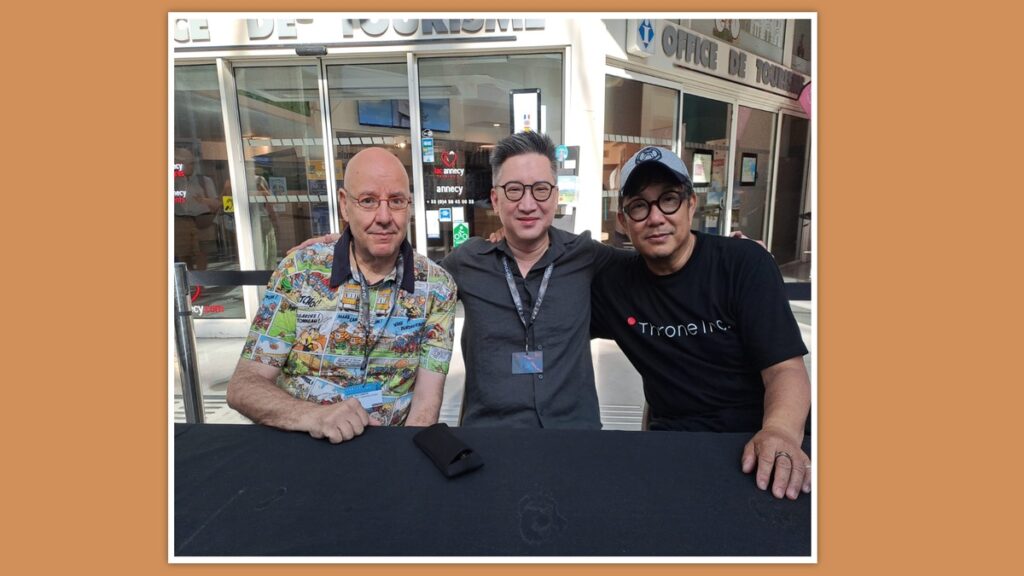
Representing Southeast Asia at Annecy
“I’ve been coming to Annecy for many years. It’s been part of my creative journey for many years. What makes The Violinist especially meaningful is that it isn’t simply representing Singapore, it’s representing Southeast Asia,” shared Han.
He pointed out that most Asian representation at Annecy comes from countries with much larger animation industries. “To bring a Singaporean feature here is incredibly meaningful. I’m very proud and humbled.”
Although The Violinist is rooted in one place and one historical moment, the film is really about the universality of the human condition.
“The friendship between Fei and Kai represents something profoundly universal. The setting is deeply Southeast Asian, but emotionally the film belongs to everyone. Unfortunately, the themes are also painfully relevant today. The film is about people trying to survive during unimaginable circumstances, and music becomes their emotional refuge,” Garcia pointed out.
Music as a character and film’s relevance today
The film follows the friendship between Fei and Kai, whose bond is forged through music even as war tears apart the world around them. For Garcia, that relationship represents the emotional core of the feature.
“Music isn’t simply part of the soundtrack, it is a character. It grows throughout the film. Its tone, maturity and emotional presence evolve alongside the characters. It has its own dramatic journey,” Han noted.
One of the striking aspects of The Violinist is how naturally it resonates with contemporary global events. However, those parallels were never intentional.
“We simply wanted to tell a truthful historical story,” Han explained. “But as we developed the film, it became impossible not to notice the similarities with what’s still happening around the world.”
For him, the horrors of war make the importance of music and culture even more apparent. “In every war, innocence is lost. Survival becomes the greatest struggle. Sometimes music and art itself becomes the only thing capable of connecting people,” said Han.
Yuki echoed that sentiment from the perspective of a Japanese producer. “The power of culture and the power of art can achieve things that politics sometimes cannot. Art has the ability to connect different people.” Through this project, he acknowledges his friend Han’s point of view.
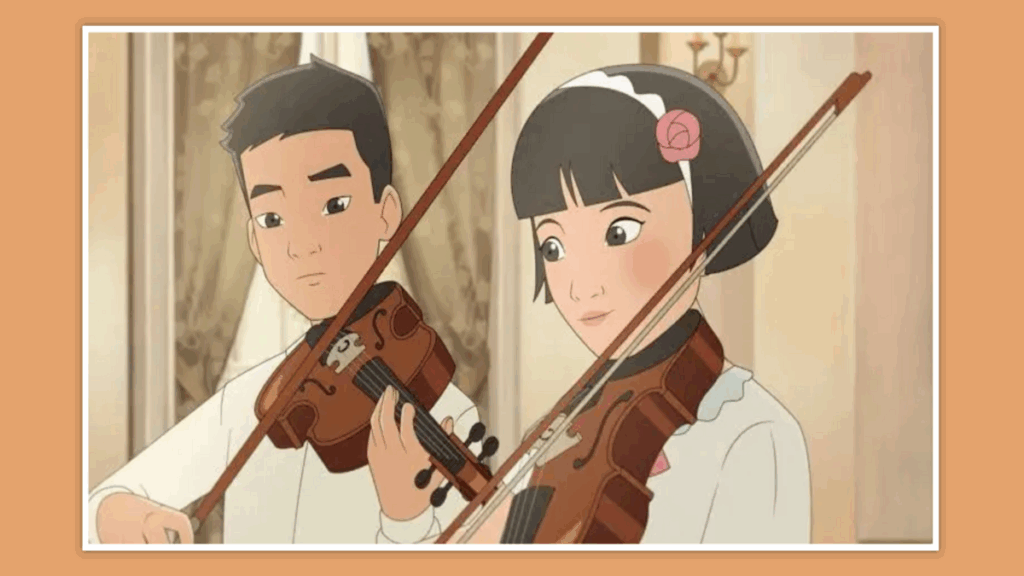
Creating a visual language between anime and Europe
Visually, The Violinist refuses to belong entirely to any one tradition.
Rather than trying to imitate Japanese anime or European animation, Han wanted the film to develop a language of its own. “The first thing we established was the tone. We certainly drew inspiration from anime, but we also looked at many European artistic traditions.”
For Han, that hybrid identity reflects Southeast Asia itself, a region shaped by multiple artistic and cultural influences. “I don’t think there’s a clearly defined Southeast Asian animation style yet. So we wanted to create something that draws from different traditions while still finding its own voice.”
He further mentioned, “We wanted the tone to carry a sense of respect and restraint. There’s nostalgia, there’s grief and ultimately there’s healing.”
Garcia explained that every animation tradition carries its own unspoken visual language. “We knew from the beginning that we wanted to combine different artistic traditions. It’s not anime in the conventional sense, and it’s not purely European either.”
Elaborate production involving hundreds of artists
Considering the film revolves around musicians, the score naturally became one of its most important creative pillars. Han revealed that two composers collaborated closely on the soundtrack.
“Our principal composer was Ricky Ho, probably Singapore’s most accomplished music composer,” Han said. Ho developed the film’s central musical identity. Spanish composer Isabel Royán later joined the project to complement specific sequences.
While The Violinist may be a Singaporean production at its core, it ultimately became an international creative effort. According to Han, production officially lasted close to four years, across ten countries.
“Singapore has a relatively small animation industry, so we collaborated with studios and artists across the region and beyond,” he shared. That collaboration eventually included teams from Japan, Taiwan, Thailand, Vietnam, Indonesia, the Philippines, Canada and Colombia.
Different cultures, artistic traditions and creative voices came together to tell a story that, while deeply rooted in Southeast Asia, ultimately belongs to audiences everywhere. Instead of standardising performances for an international audience, the production embraced authenticity.
“Our Japanese characters speak authentic Japanese. Our Singaporean actors speak naturally with Singaporean accents,” Garcia highlighted. He pointed out that the children in the film are voiced by actual children.
All three filmmakers agreed that experimentation is essential to animation, but never at the expense of authenticity. They emphasised that while The Violinist embraces diverse artistic influences, its emotional honesty and cultural specificity remain at the heart of the film.
As The Violinist continues its international journey following its historic Annecy triumph, the filmmakers hope audiences will look beyond its wartime setting and connect with its enduring message of compassion, resilience and shared humanity. Built over nearly a decade and realised through the efforts of hundreds of artists across ten countries, the feature stands as a testament to the power of international collaboration and the growing ambitions of Southeast Asian animation.


