
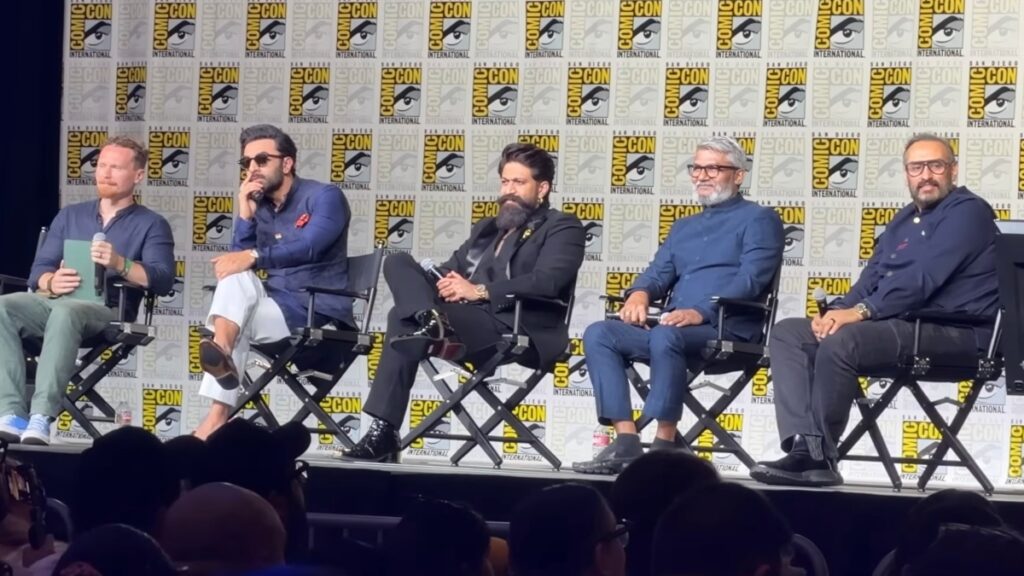
Bollywood didn’t gatecrash Comic-Con. It notched an arrow, took aim at the world’s rowdiest pop-culture bazaar, and let fly.
On 23 July, the makers of Ramayana marched into Ballroom 20 and turned San Diego’s fanboy Mecca into a shrine of hype, only the second Indian film to command a marquee panel there after Kalki 2898 AD. Front and centre: Ranbir Kapoor as Lord Ram, KGF colossus Yash as the ten-headed Ravana, director Nitesh Tiwari, and producer Namit Malhotra, the man signing the cheques.
And what cheques they are. Mounted on a reported Rs 4,000 crore, about US$500 million across both instalments, this is, by Malhotra’s own unblushing estimate, the largest film in the world for the greatest of epics. No pressure, then.
Kapoor, for one, felt every kilo of it. He admitted the offer first landed as fear and self-doubt before it “turned into gratitude”, a once-in-a-lifetime shot and, as he put it, a moral responsibility. Lord Ram, he reminded the room, has been the conscience-keeper of millions for over 4,000 years: the Maryada Purushottam, the ideal son, husband, brother and king rolled into one. Big sandals to fill.
There’s a tidy full-circle here that no scriptwriter would dare invent. Ranbir’s great-grandfather, the legendary Prithviraj Kapoor, played Ram in the 1930s Bengali talkie Seeta, the first Indian talkie to screen at Venice. Nine decades on, the bow passes back to the bloodline. Some roles, it seems, are heirlooms.
If Kapoor carries the halo, Yash gets the horns. The KGF superstar, who also co-produces through his Monster Mind Creations, is relishing Ravana as cinema’s original antihero, the “OG villain” whose menace springs from unshakeable, if misguided, conviction. He was quick to bow to his on-screen rival, too, calling it no easy feat to play Lord Ram and heaping “huge respect” on Kapoor’s surrender to the part. Chivalry, evidently, survives even between Ayodhya and Lanka.
For Tiwari, the Dangal director who knows a thing or two about box-office muscle, the challenge was reverence without rigor mortis. He revealed he had unearthed over 300 versions of the Ramayana across India, each fiercely revered, and leaned on scholars at every turn, running scenes past them to learn what could be tweaked and what was strictly off-limits. The brief: keep the sanctity intact, yet make it crackle for a global audience.
Malhotra, meanwhile, brought the muscle behind the myth. As global CEO of DNEG, the visual-effects house behind seven Oscar-winning spectacles including Dune and Tenet, he has spent two decades building the pipeline this film demanded, capturing live and digital actors on set simultaneously. Every flying elephant and the soaring Pushpak Vimana, he insists, is drawn from the text, not conjured from thin air. The word “avatar”, he noted with a grin, was Sanskrit long before it became a Hollywood billion-dollar franchise.
The globe-spanning ambition doesn’t stop at the screen. The score pairs Hollywood’s Hans Zimmer with maestro A.R. Rahman in a full-blooded East-meets-West embrace; Mad Max stunt supremo Guy Norris choreographs the mayhem; and Sony Pictures will fire the film into cinemas worldwide, every frame shot for Imax.
So, will it hit the bullseye? Ramayana Part one draws its bow for Diwali 2026, Ramayana part two for Diwali 2027. Two films, five millennia of myth, and a small nation’s worth of pixels riding on a single arrow. Miss, and it’s a very expensive misfire. Hit, and Bollywood may just have loosed the shot heard round the world.
