

Creating compelling visuals has evolved from a creative advantage into an essential requirement for content creators navigating today’s highly competitive landscape. In this context, the Indian visual effects industry continues its journey towards establishing itself as a global powerhouse.
According to the FICCI EY 2026 report titled ‘Stories, scale and impact’, the animation and VFX segment jointly recorded a modest 1.6 percent growth in 2025, indicating early stabilisation after the sharp decline in 2024. The report reveals that the animation, VFX and post-production segment is expected to grow at 10 per cent from Rs 105 billion in 2025 to Rs 138 billion by 2028.
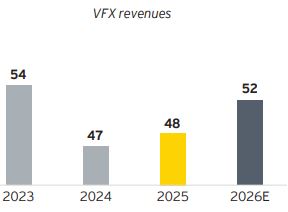
Here’s an overview of what took place in 2025:
VFX recalibrated in 2025
- 2025 marked a phase of structural normalisation for global film and TV production after the volatility of 2024
- Content volumes increased, but VFX services were re-priced, with fewer premium builds and a preference for leaner pipelines and shorter delivery timelines
- Several established VFX networks shut down or scaled back operations, despite strong creative credentials and long-standing client relationships:
- Technicolor’s 2025 shutdown disproportionately affected India, displacing up to 2,000 VFX and animation professionals in Bengaluru
- Jellyfish Pictures halted global operations in 2025, impacting over 100 artists in Mumbai
- Despite these challenges, Scanline and Barnstorm expanded into Hyderabad, signaling continued global interest in India’s VFX talent base
- The downturn accelerated consolidation among Indian VFX players, with Phantom FX acquiring Milk VFX and Lola Post
Film demand increased and steadied shot volumes
- Domestic film producers increased the use of VFXand post-enhancement in 2025
- This broadened baseline shot volumes and expanded post-enhancement spending beyond a narrow set of tentpole titles
- While tentpole films allocated 25 per cent to 30 per cent of their budgets to VFX and post-enhancement, midbudget films increased VFX utilisation to 10 per cent to 15 per cent of budgets
AI reshaped VFX economics
- To offset lower pricing, VFX studios embedded AI across workflows
- AI adoption in roto/ paint, clean-up, asset variation, tagging, QC and pipeline orchestration delivered up to 40 per cent time savings
- Global surveys indicate particularly strong efficiency gains in rotoscoping:
- Around 20 per cent time savings in action films and 40 per cent in period films
- 55 per cent to 65 per cent time savings in VFX‑heavy genres such as sci‑fi, fantasy and horror
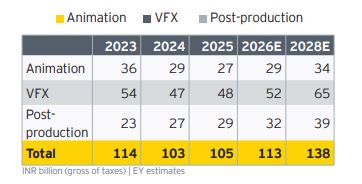
As the the animation, VFX and post-production segment is jointly estimated to reach Rs 138 billion in 2028, the growth drivers include:
- Stable domestic content production demand across films and TV, with increased VFX and post-production services in mid-budget films
- Rising demand for premium OTT content as platforms scale and regional players consolidate or partner
- Higher demand for professional short video content, ad films and micro-dramas
- Increased investment in low-cost animation for children, young adults and anime
- Real-money game development for global markets; video game development for India
- Increased demand from global studios, which are increasingly focused on profitability
To read the EY FICCI 2026 report titled ‘Stories, scale and impact’, click here.
Also, Read: FICCI EY Report 2026: Indian animation sector records six per cent decline
