

Animation speaks a universal language with a truly global resonance. In today’s digital era, animated visuals have seamlessly permeated sectors such as healthcare, technology, education, and banking, enabling clearer communication and deeper audience engagement. Despite its wide-ranging impact, the animation industry faced a slowdown in 2025.
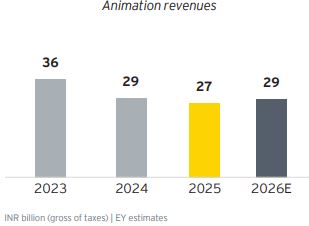
According to statistics provided by the FICCI EY 2026 report titled ‘Stories, scale and impact’, the Indian animation sector contracted by six per cent and the revenue touched Rs 27 billion (in 2024 it was estimated to be Rs 29 billion).
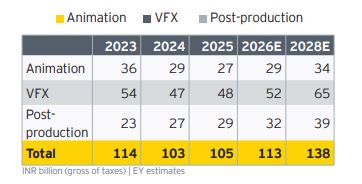
However, industry leaders remain optimistic as we progress into 2026. The segment is expected to grow at 10 percent from Rs 105 billion in 2025 to Rs 138 billion by 2028.
Here’s an overview of what took place in 2025:
Animation commissioning remained subdued in 2025
- The reduction in commissioning activities through 2025 continued to pressure pricing, capacity utilisation and slate visibility for Indian studios
- Western markets, particularly the US, which contributes over 50 per cent of global content spending, led the slowdown:
- US commissioning remained weak, with orders down 11 per cent over the previous year
- US animated-series production grew just 0.6 per cent between 2018 and 2024, and TV’s share of total animated series output dropped from 48 per cent to 30 per cent
- Leading streamers reduced animation slates; at Netflix and Apple TV+, annual animated series orders fell from 15 titles in 2022 to just five by 2025
- Domestic commissioning was impacted by declining Linear TV homes, lower kids targeted FMCG advertising, and a seven per cent reduction in OTT hours commissioned
- Greenlighting moved away from experimentation, shifting instead towards selective, franchise adjacent bets with clearer visibility on returns
Shared ownership and co-funding models increased
- Greenlighting became more viability-led, with co-funding, IP sharing and cross-format extensions emerging as standard mechanisms to de-risk investments
- Examples of such partnerships included:
- Zebu Animation and Studio Jatayu co‑developing Academy of Gods
- Prayan Animation partnering with Moonstar (US) to co‑develop Shelly & Friends
- Digitoonz Spain collaborating with Drilo and The Gang and Maskeline to co‑develop and scale animated IP
- 88 Pictures and Gaumont Animation partnering for High in the Clouds
IP monetisation expanded beyond content
- Studios shifted to multi‑vector IP economics, integrating content, commerce and distribution to reduce revenue cyclicality
- Monetisation expanded beyond produced content into FAST channels, education, gaming, consumer products, experiences and international distribution. Some illustrative examples include:
- Green Gold Animation scaled revenue through Green Gold TV (FAST), Learn with Bheem
- (edutainment) and Bheem Café (experiential)
- Toonz Media strengthened its portfolio through international licensing (Creepy Candy) and product‑integrated IP development (Hangry Petz with JayPlay)
- Powerkids grew The Jungle Book and Akira Mowgli through European merchandising, and Digitoonz expanded global distribution via its partnership with Canela Media
Young-adult animation and anime-influenced formats performed well
- Globally, adult animation increased its share of the total output from 26 per cent in 2019 to 41per cent in 2024
- In India, interest in young adult and mythological animation accelerated:
- Kurukshetra entered the Netflix India Top 1015
- Legend of Hanuman S6 drew 5.8 million viewers in three days
- Mahavatar Narsimha grossed INR3 billion in theaters
- Anime consumption rose sharply:
- India reached 118 million anime viewers, with 50per cent of gen Z and millennials watching weekly
- Theatrical releases expanded from five to six annual releases (pre-2020) to 15 to 16 films a year
- Franchises such as Demon Slayer released across 600+ Indian cities
To read the EY FICCI 2026 report titled ‘Stories, scale and impact’, click here.
