There was a particular cruelty in a day off that wasn’t one. For millions of working mothers, Saturday arrived not as rest but as a reckoning, the accumulated domestic debt of the week, now due. Because Today Is Saturday, an animated short by Portuguese director Alice Eça Guimarães, took that single, unremarkable day and found an entire social argument inside it.
The film was selected for Annecy, animation’s most prestigious festival. It deserved the attention.
Its premise was spare. A woman held a full-time job. Her one official day away from the office was Saturday. Saturday, it turned out, belonged to the household. The laundry, the cooking, the cleaning, the work that generated no income, appeared on no contract, and earned no acknowledgement, waited patiently for her. It always did.

Guimarães was candid about what drove her to the subject. Despite her own conscious efforts to distribute domestic responsibilities fairly, she found the expectation settling on her shoulders anyway, quietly, persistently, and simply because she was a woman. Motherhood made the weight heavier still. She acknowledged that she was more fortunate than many: she had family support and the means to seek help. That fortune was precisely what made her curious about those without it. Her protagonist was that woman, one for whom the second shift was not an occasional inconvenience but the defining architecture of her days. “She desperately needs some time for herself, to think, to reflect, to create,” the director said, “but there are not enough hours in the day.”
The title carried its own literary provenance. It was drawn in part from O Dia da Criação, a poem by Brazilian lyricist Vinicius de Moraes, in which Saturday was rendered almost ceremonial, a rupture in routine, a day when the ordinary gave way to something larger. Guimarães appropriated that promise and inverted it. The sacred day became the day of unpaid labour. The possibility became another obligation. The irony was quiet but unsparing.
Simone de Beauvoir supplied the film’s intellectual backbone. Her comparison of housework to the torture of Sisyphus, an endless cycle of repetition that yielded no reward and left no mark became one of its emotional foundations. The image was accurate in a way that more polite descriptions of domestic inequality were not: the work was done, it undid itself, and it had to be done again. Recognition was not part of the arrangement.
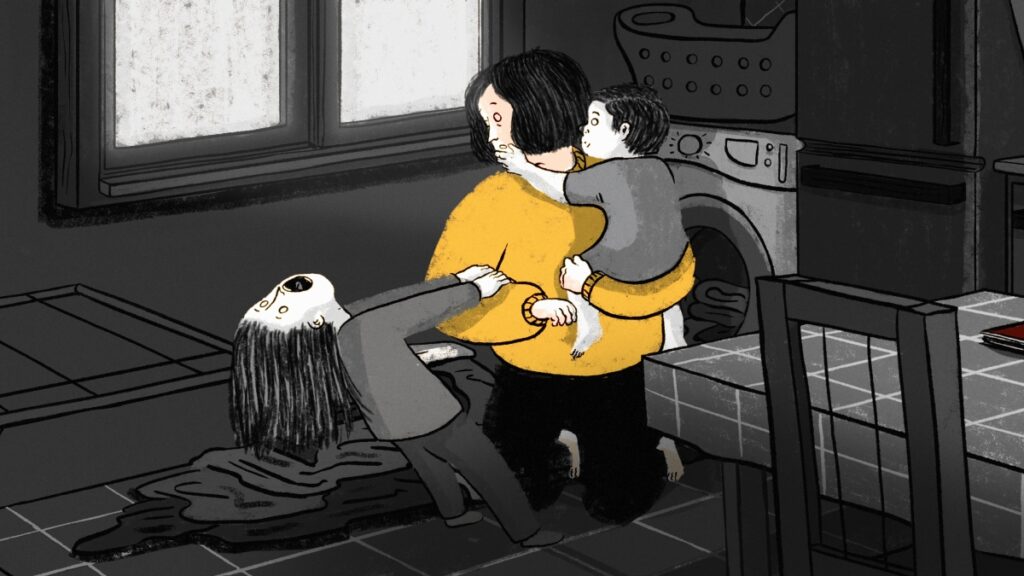
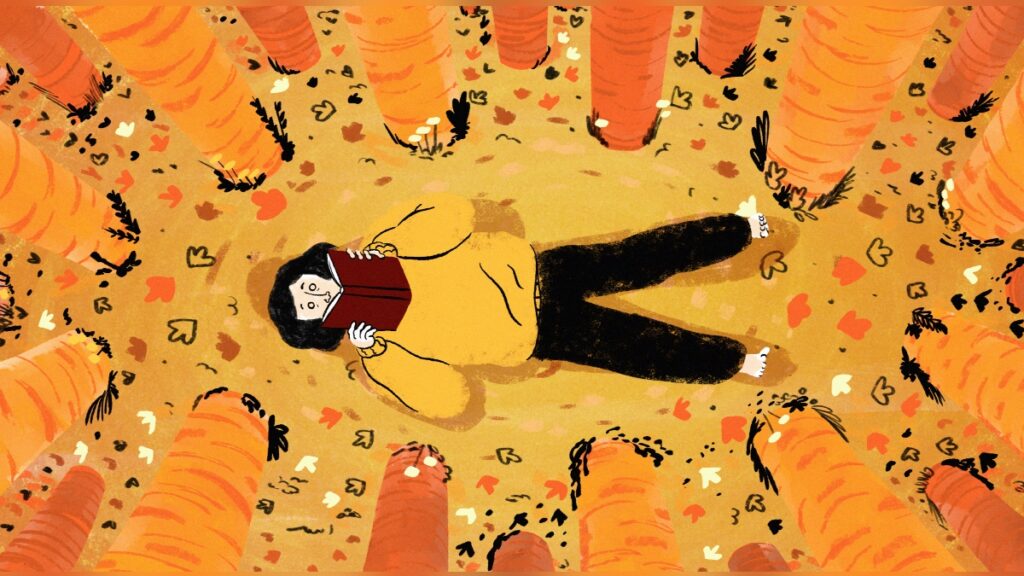
Animation gave Guimarães the tools to make that feeling visible rather than merely described. She constructed two worlds in deliberate opposition. Inside the house, the frame contracted. Walls pressed inward. The space grew claustrophobic as the day wore on. Outside, a garden the protagonist’s interior life given form, expanded without limit, vivid and uncontained. The colour palette enforced the division: the woman was the only figure rendered in colour within the domestic space, visually isolated from everything around her. In the garden, she dissolved into the landscape. She was no longer a figure against a backdrop but part of the world itself.
The film’s most striking sequence drew on Sylvia Plath. The protagonist concealed her soul from those around her, eventually locking it away beside her diary. It was a precise and troubling image, not of dramatic breakdown but of gradual, almost administrative self-erasure. Dreams, creative identity and the private self were all filed away because there simply was no time for them.
Guimarães assembled a substantial intellectual framework during production. A feminist book club she joined during development brought her to La Charge Mentale, A Room of One’s Own, Invisible Women, We Should All Be Feminists and The Bell Jar. The influences were present in the film without dominating it. It argued by image rather than by citation.
The emotional material came from closer still, her mother, sisters, friends and mother-in-law, women who carried not only the physical weight of domestic work but the subtler, less visible labour of emotional maintenance: anticipating needs, absorbing anxieties and holding households in equilibrium. That labour, too, went largely unrecorded.
What distinguished Because Today Is Saturday from more programmatic feminist filmmaking was its refusal of easy targets. There was no antagonist. There was no confrontation scene. The film was uninterested in assigning blame and deeply interested in something harder to dramatise: the structural conditions under which a woman’s time, creativity and inner life were the first things surrendered when the hours ran out. Guimarães was equally impatient with the superwoman myth, the cultural fantasy that a woman could absorb all of this and still flourish. “It’s exhausting,” she said plainly. “It takes a big toll on women. It shrinks their world and their capacity to dream, reflect, create.”

One sequence was cut entirely during production: a segment exploring the protagonist’s fear of becoming pregnant again. Guimarães found it disrupted the film’s rhythm, however true it rang. The decision, she reflected, reinforced a lesson most directors learned the hard way, the story’s integrity had to outrank the filmmaker’s attachment to any single idea.
What remained was lean, precise and quietly devastating. Because Today Is Saturday did not ask for outrage. It asked for recognition, of the labour that held ordinary life together and the cost, measured in unlived hours, that fell most heavily on the women who performed it.

