India has millions of gamers. What it does not yet have is enough game developers capable of producing titles that can match the world’s best. Manvendra Shukul believes that gap can be closed. But it will take more than training young talent. It will take experience, investment and a serious understanding of what makes a great game.
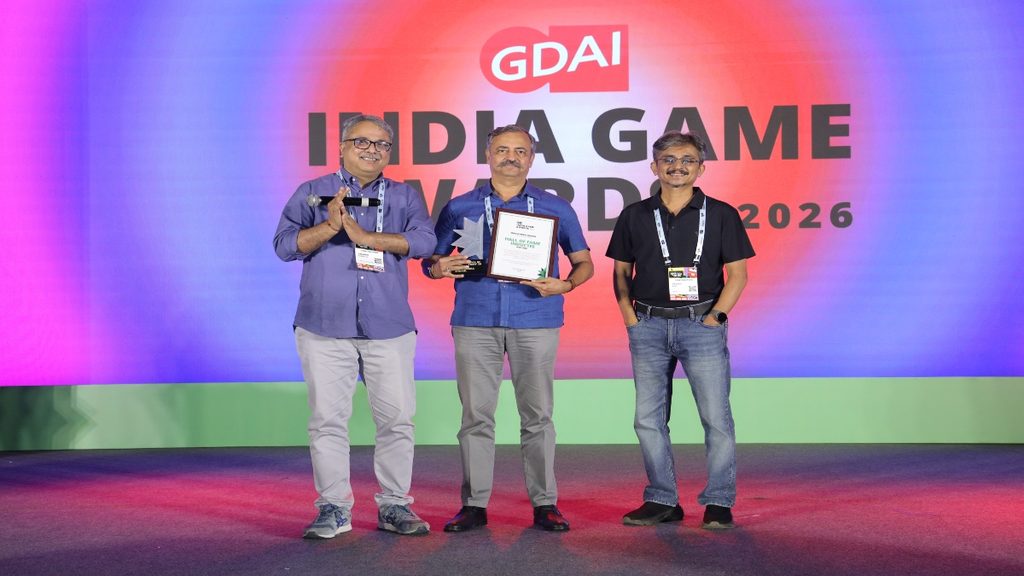
The founder and chairman of Lakshya Digital has spent more than three decades in the video games and animation business. His contribution to the industry was recognised at the 18th edition of the India Game Developer Conference (IGDC) 2026 in Chennai, where he received the Hall of Fame Award.
It is an important milestone in a journey that began in 2004 with six people working out of Gurgaon. Today, Lakshya has more than 1,000 professionals across eight locations worldwide and has contributed to more than 175 AAA game titles.
The company’s work features in some of the biggest names in gaming, including Elden Ring, Baldur’s Gate 3 and Alan Wake II. For Shukul, however, building Lakshya was only the first part of the journey. The next step is to move beyond providing services and explore partnerships to develop complete games.

“We have done more than what I had anticipated in the beginning,” he said. The company, he believes, is now well placed to work with global partners on full-scale game development.
That ambition comes against a difficult backdrop for India’s gaming industry. Shukul sees the biggest weakness not in the availability of young talent, but in the lack of experienced professionals who understand the demands of making games at an international level.
The problem is time. Developers in the West have spent 40 to 45 years building their expertise. Indian studios cannot afford to take the same route. A fresher may take several years to become proficient enough to work on a globally competitive title. By then, valuable time has been lost.
Shukul wants the government to help bridge that gap. One proposal is to subsidise the cost of bringing experienced international professionals into Indian development teams. An experienced art director, technical director or game designer could help a young studio raise the quality of its work much faster.
The opportunity is considerable. Making games in the West has become expensive. Publishers and developers are looking for ways to control costs without compromising quality. India could be an attractive destination, provided it can offer the right talent and a predictable policy environment.
Shukul says global companies are interested in India, but uncertainty around government policies and the availability of experienced talent continue to hold back larger investments. Companies such as Ubisoft, EA (Electronic Arts, an American video game developer) and Rockstar have already established a presence in the country. He believes many more could follow if these concerns are addressed.

For a small studio with two or five people, access to money could make the difference between an unfinished prototype and a game ready to be pitched to a publisher. It could also help the studio hire experienced professionals and improve the quality of its product.
Shukul’s views on artificial intelligence are equally grounded. The technology can help with coding and speed up certain processes, and studios have begun experimenting with it. But he does not see it replacing the creative thinking that goes into making a game.
“A game is more than just code,” he argues. It is about designing an experience and making the player feel something. That, he believes, is where human creativity will continue to matter.
The industry veteran’s own entry into gaming came in 1995, when Wolfenstein 3D caught his attention. A programmer by training, Shukul was fascinated by the shift from the two-dimensional games he knew to an immersive three-dimensional environment. He began reading books, speaking to engineering professors and developing his own game engine.
That early experiment led to the sale of his company for its technology. He subsequently moved into animation, setting up Escotoonz in 2001, before founding Lakshya three years later.
The rest has been a steady climb. The six-member operation has grown into a global studio working with some of the world’s leading game developers. Shukul also helped build the wider industry ecosystem, co-founding the Nasscom Gaming Forum and IGDC and serving on the board of the Game Developers Association of India.
His advice to young developers is straightforward: know the global benchmark before setting out to beat it. Spend time on game design and mechanics. Build the right team. Do not rush a game simply to get it out of the door.
And learn to live with failure. In an industry still finding its feet in India, mistakes are inevitable. What matters is learning from them and staying the course.
